
Reducing Retinal Blindness Worldwide
- Retina Research Foundation
- About RRF
- Pilot Study Grants
- Grant Recipients 2026
- Yingbin Fu, PhD
- Wei Li, PhD
- Yuqing Huo, MD, PhD
- Rinki Ratnapriya, PhD
- Rui Chen, PhD
- Wenbo Zhang, PhD
- Curtis Brandt, PhD
- Lih Kuo, PhD
- Timothy Corson, PhD
- Jianhai Du, PhD
- James Monaghan, PhD
- Seongjin Seo, PhD
- Andrius Kazlauskas, PhD
- Ann C. Morris, PhD
- Christine Sorenson, PhD
- Jeffrey M. Gross, PhD
- David M. Wu, MD, PhD
- Kinga Bujakowska, PhD
- Eric Weh, PhD
- Ching-Kang Jason Chen, PhD
- Jakub K. Famulski, PhD
- Thanh Hoang, PhD
- Georgia Zarkada, MD, PhD
- Eleftherios Paschalis Ilios, PhD
- Oleg Alekseev, MD, PhD
- Erika Tatiana Camacho, PhD
- Patricia R. Taylor, PhD
- Elizabeth Vargis, PhD
- Ximena Corso Díaz, PhD
- Michael Landowski, PhD
- Brian Perkins, PhD
- Carlos S. Subauste, MD
- Rebecca Voorhees, PhD
- Publications
- Grant Guidelines and Information
- Grant Application
- Grant Recipients 2026
- Research Programs
- Contact Us
- Giving
- RRF History
- Home
Oleg Alekseev, MD, PhD
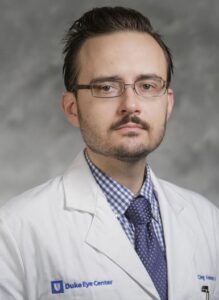 Department of Ophthalmology
Duke University School of Medicine
Durham, NC
BASIC RESEARCH PROJECT
Development of gene supplementation therapy for PROM1 associated inherited retinal degenerations
Research Interests
Inherited retinal diseases are caused by defects in the genetic code
and result in devastating blindness. Mutations in the prominin-1 gene (PROM1) are well known to cause severe and irreversible vision loss, for which there is currently no cure. One promising treatment option is gene therapy, which is used to deliver a healthy copy of the mutated gene to the patient’s retina. Gene therapy is a powerful approach that has the potential to stop vision loss, or even partially restore vision. Dr. Alekseev’s laboratory has created a gene therapy for PROM1 disease and successfully treated the recessive condition in mice. However, PROM1 mutations often cause a different, dominant type of disease, which may or may not be treatable with gene therapy.
There are many different versions of prominin-1 throughout the human body, and it is unclear which one of them is the preferred configuration of PROM1 in the human retina. Dr. Alekseev has identified the most prevalent version of human retinal PROM1 and used this knowledge to make a gene therapy. Dr. Alekseev deployed this gene therapy to treat a recessive mouse model that lacks PROM1 and observed a remarkable improvement in retinal anatomy. Encouraged by the success of this gene therapy in the recessive model, the team now seeks to understand whether this gene therapy will also be able to treat dominant disease. Other investigators had previously characterized a mouse model of dominant PROM1 disease, and their findings strongly suggest that it may indeed be amenable to gene therapy treatment. Therefore, Dr. Alekseev and his team hypothesize that the gene therapy will be able to treat not only the recessive prominin-1 disease but also its dominant counterpart.
Plans for 2026
The purpose of the project is to determine whether dominant PROM1 disease is also amenable to gene therapy treatment.
Throughout 2026. Dr. Aleskeev will focus predominantly on validating his lab’s PROM1 gene therapy in the dominant mouse model. These investigations will aim to explore the extent of the anatomic and functional therapeutic effect, as well as its longevity. To reflect the patient population more accurately, the lab will also evaluate the ability of this gene therapy to provide benefit at more advanced stages of disease by treating mice with dominant PROM1 disease at an older age-range.
Specific Aims: To explore the therapeutic scope of this exciting new gene therapy, Dr. Alekseev will create and characterize a mouse model of dominant PROM1 disease. This model will mimic the most commonly encountered dominant PROM1 mutation in humans. The lab team will then rigorously test their PROM1 gene therapy in this mouse model to evaluate the treatment effect on retinal anatomy, visual function, and functional vision. These studies have the potential to expand our understanding of the mechanisms underlying PROM1 dominant disease, and to help identify patient populations that could benefit from PROM1 gene therapy.
Progress in 2025
Our most significant advance was the successful transition from using
a mouse-based gene therapy construct to developing a human-based PROM1 gene
therapy. Many different versions of PROM1 exist, and it has been unclear which one of
them is the preferred configuration in the human retina. We conducted an extensive study
in mice, based on which we selected the ideal PROM1 gene therapy prototype and are
currently optimizing its dosage for maximal safety and efficacy. We have encountered a
setback pertaining to the generation of the new mouse model of dominant PROM1
disease. To overcome this challenge, we have already implemented an alternative
strategy to derive this mouse model.
Type of Project: Translational research.
