
Reducing Retinal Blindness Worldwide
- Retina Research Foundation
- About RRF
- Pilot Study Grants
- Grant Recipients 2026
- Yingbin Fu, PhD
- Wei Li, PhD
- Yuqing Huo, MD, PhD
- Rinki Ratnapriya, PhD
- Rui Chen, PhD
- Wenbo Zhang, PhD
- Curtis Brandt, PhD
- Lih Kuo, PhD
- Timothy Corson, PhD
- Jianhai Du, PhD
- James Monaghan, PhD
- Seongjin Seo, PhD
- Andrius Kazlauskas, PhD
- Ann C. Morris, PhD
- Christine Sorenson, PhD
- Jeffrey M. Gross, PhD
- David M. Wu, MD, PhD
- Kinga Bujakowska, PhD
- Eric Weh, PhD
- Ching-Kang Jason Chen, PhD
- Jakub K. Famulski, PhD
- Thanh Hoang, PhD
- Georgia Zarkada, MD, PhD
- Eleftherios Paschalis Ilios, PhD
- Oleg Alekseev, MD, PhD
- Erika Tatiana Camacho, PhD
- Patricia R. Taylor, PhD
- Elizabeth Vargis, PhD
- Ximena Corso Díaz, PhD
- Michael Landowski, PhD
- Brian Perkins, PhD
- Carlos S. Subauste, MD
- Rebecca Voorhees, PhD
- Publications
- Grant Guidelines and Information
- Grant Application
- Grant Recipients 2026
- Research Programs
- Contact Us
- Giving
- RRF History
- Home
Wei Li, PhD
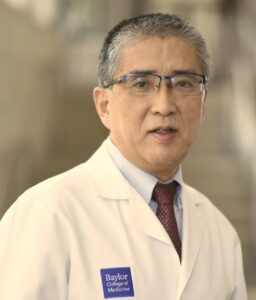 Department of Ophthalmology
Baylor College of Medicine
Houston, TX
BASIC RESEARCH PROJECT
Identifying a receptor for disease-targeted anti-angiogenic therapy of wet AMD
Research Interests
Wet age-related macular degeneration (AMD) is a major cause of vision loss in older people. It happens when abnormal blood vessels grow in the eye and damage vision. Current treatments try to stop this growth, but they also affect healthy blood vessels, which can cause side effects and aren’t always effective. Dr. Li’s laboratory team discovered a protein called Scg3 that only promotes the growth of harmful blood vessels. the lab has developed special antibodies that block Scg3, stopping the bad vessels with sparing the good ones. When this new treatment is combined with existing ones, they work even better together. Our next line of inquiry is to understand exactly how Scg3 works by finding the exact “docking site” (called a receptor) on the diseased blood vessels where Scg3 attaches. This could help us make the treatment more effective and lead to new therapies that target the receptor directly.
Plans for 2026
In 2026, Dr. Li’s lab aims to develop a new treatment that blocks Scg3 from attaching to its receptor. To do this, the team will try to narrow down the important part of the receptor from 130 to about 30 building blocks. Once Dr. Li finds that critical piece,the team will make antibodies to block it, thereby creating a new kind of therapy that targets the receptor itself. This research could lead to a new, more precise and safer treatment for wet AMD by targeting a specific receptor found only on harmful blood vessels, thereby avoiding the side effects of current therapies.
Progress 2025
Dr. Li has developed an innovative technology for screening molecular therapeutic targets and discovered a disease-targeted, anti-angiogenic therapy against a novel disease-selective angiogenic factor. Dr. Li validated the unique properties of this therapy, which has significant efficacy and safety advantages for the therapy of wet age-related macular degeneration (AMD) over the currently available therapy, including minimal side effects on healthy vessels. Importantly, combination of this novel therapy with currently available anti-angiogenic drugs synergistically further improves treatment efficacy in the animal models Dr. Li has developed. Identifying the unknown receptor for the novel disease-selective angiogenic factor is crucial for supporting the synergistic combination therapy and potential clinical translation. Preliminary studies identified a putative receptor.
The purpose of Dr. Li’s 2025 project was to independently validate the newly-identified putative receptor as the genuine receptor of the disease-selective angiogenic factor, which is essential to mediate the disease-targeted anti-angiogenic therapy. The project found a protein that acts as the Scg3 receptor. While this protein is found on many cells, Dr. Li’s laboratory discovered a special version of it—with an extra segment about 130 building blocks long—that only appears on the diseased blood vessels. Animal studies confirmed that this version is key to how Scg3 causes damage in wet AMD.
